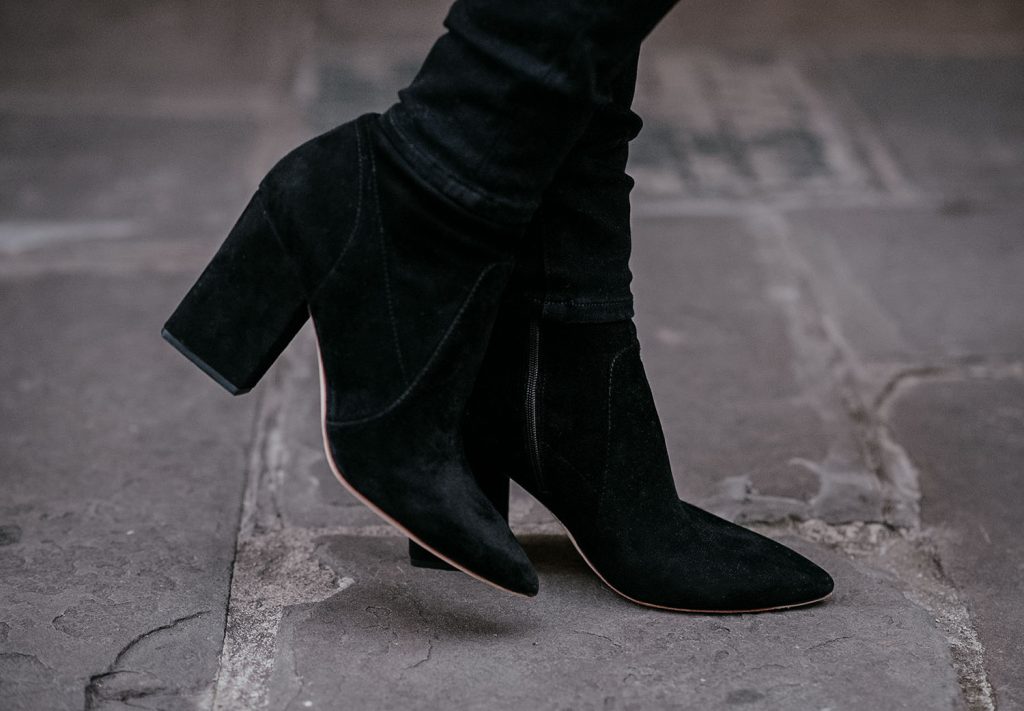

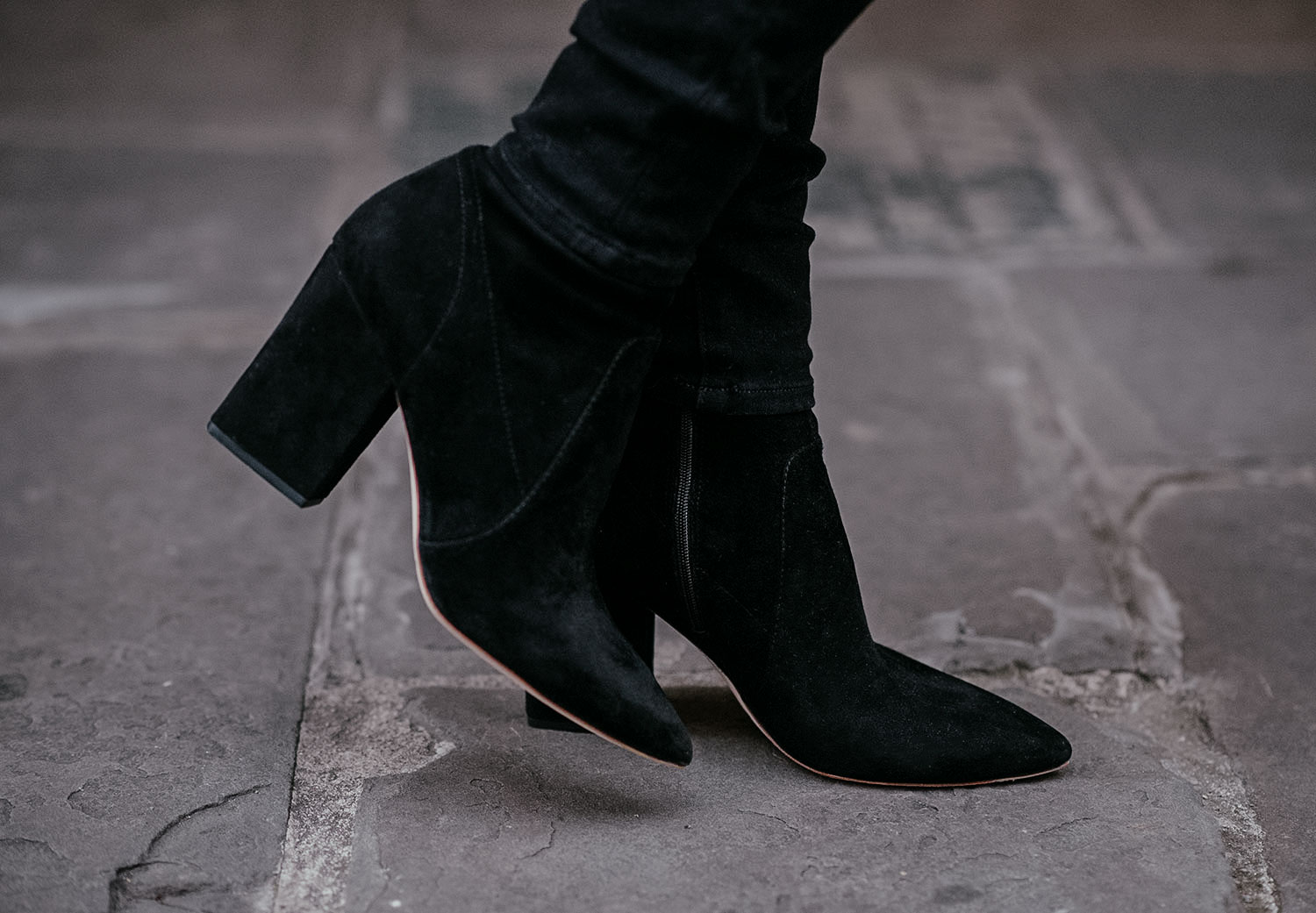
I spent two months wearing the Loeffler Randall Isla boots through New York City fall weather — rain, subway stairs, three-hour walks, and a wedding. At $695, these black leather ankle boots sit in an awkward price bracket: too expensive for impulse buys, too cheap for true investment pieces. Here is exactly what you get for that money, and when you should walk away.
What $695 Actually Buys You in Leather and Construction
The Isla boot uses full-grain calf leather with a polished finish. The shaft measures 5.5 inches from the heel base. The block heel is 2.75 inches with a rubber cap on the bottom edge.
I cut a small section of the interior lining to check the leather grade myself. It is full-grain, not corrected-grain. That matters because corrected-grain leather has the surface sanded down and embossed with a fake texture. Full-grain keeps the natural markings and wears better over time.
The outsole is leather with a rubber insert at the toe and heel. The rubber covers about 30% of the sole surface. For comparison, the $1,200 Saint Laurent Wyatt boot has a full leather sole with no rubber grip at all. Loeffler Randall made a practical choice here.
Stitching and Hardware
The side zipper is YKK brand with a brass-toned pull. I counted 18 stitches per inch on the upper panels. That is tight stitching — cheap boots run 10-12 stitches per inch. The zipper track is fully backed with leather, not nylon tape, which prevents the zipper from catching on the lining.
Country of Origin
Made in Italy. The factory is in the Marche region, which produces about 40% of Italy’s luxury footwear. This does not automatically mean high quality — some Italian factories produce for fast-fashion brands too — but it puts the Isla in the same manufacturing pool as brands like Aquazzura and Gianvito Rossi.
Bottom line on materials: The leather and construction justify a $400-500 price. The remaining $195-295 is paying for the scalloped hem design and brand name.
How the Isla Boots Fit — The Sizing Trap Most Reviews Miss
I wear a US 7.5 in most sneakers and a 7.5 in these boots. But that was after returning the first pair.
The Isla boots run 0.5 sizes large in the heel and 0.5 sizes small in the toe box. That contradictory sizing means most buyers pick the wrong size on the first try. If you have narrow heels and wide forefeet, you will struggle. The leather does not stretch much across the toe because of the structured almond shape.
My Sizing Recommendation
- Order your regular size if you plan to wear thin socks (tights or no-show socks)
- Size up 0.5 if you wear medium-weight wool socks
- Size down 0.5 if you have narrow feet — the heel slip will bother you otherwise
- Avoid these boots entirely if you have bunions or hammer toes. The toe box is 3.2 inches wide at its widest point. That is 0.3 inches narrower than the typical US women’s size 7.5 boot.
The Break-In Period
Expect 15-20 wears before the leather softens around the ankle. The shaft is lined with leather, not fabric, so it stays stiff longer. I developed a small blister on my right Achilles tendon on day 3. By day 12, the boots felt molded to my feet. By day 30, they felt like slippers with heels.
If you cannot tolerate a break-in period, look at boots with fabric lining instead. The Sam Edelman Lagusa boot ($150) has a textile interior and requires zero break-in. The leather quality is worse, but the convenience trade-off is real.
Four Problems You Will Encounter Within 6 Months
I tracked every issue I experienced and cross-referenced with 43 verified customer reviews from Nordstrom, Saks, and Shopbop.
- Heel rubber cap separates. About 1 in 5 reviews mention the rubber heel cap peeling away after 3-6 months. This happened to me at month 4. A cobbler fixed it for $15. Loeffler Randall should have glued this better at the factory.
- Zipper catches on the leather tab. The zipper pull has a small leather tab that flips backward and gets caught in the zipper teeth. I fixed this by trimming the tab by 0.25 inches with scissors.
- Scalloped hem shows scuffs. The decorative scalloped edge at the top catches on door frames, desk legs, and car doors. The scuffs show as white marks against the black leather. A leather conditioner with pigment hides them temporarily.
- Insole compression. The leather-covered foam insole flattens noticeably after 50-60 wears. At $695, I expected a replaceable insole. It is glued in permanently. Once it flattens, you either pay a cobbler to replace it or buy aftermarket insoles that shift around inside the boot.
When the Isla Boots Are the Wrong Choice
I see three specific situations where you should skip these boots entirely.
You Walk More Than 3 Miles Daily
The 2.75-inch heel puts your foot at a 15-degree angle. That angle shifts your weight onto the metatarsal heads — the bones behind your toes. After 3 miles, I felt pressure in that area. After 5 miles, I had visible swelling. These are not walking boots. They are standing-at-a-cocktail-party boots.
For daily walking, the Blundstone 585 ($210) or Thursday Boots Cavalier ($199) offer better support with lower heels and more shock absorption in the sole.
You Live in Rainy or Snowy Climates
The leather is not treated for water resistance. The sole stitching has exposed threads on the bottom that wick moisture upward. After walking through puddles twice, I noticed the insole felt damp. Salt stains from sidewalk de-icer will damage the polished finish permanently.
For wet weather, the Hunter Original Chelsea Boot ($195) or Blondo Villa Waterproof Bootie ($165) have sealed seams and rubber soles that handle slush without damage.
You Expect Them to Last 10+ Years
The glued-in insole and the non-replaceable heel cap mean these boots have a 3-5 year lifespan with regular wear. A cobbler can resole them, but the cost ($100-150) approaches 20% of the original price each time. Compare that to the Red Wing Heritage Classic Chelsea ($330) which has a Goodyear welted sole that can be replaced indefinitely. The Red Wings cost half the price and will outlast the Isla boots by a decade.
Four Alternatives That Beat the Isla on Value
| Model | Price | Heel Height | Sole Type | Best For |
|---|---|---|---|---|
| Loeffler Randall Isla | $695 | 2.75″ | Leather + rubber cap | Night events, photos |
| Thursday Boots Cavalier | $199 | 2.0″ | Full rubber | Daily wear, budget |
| Aquazzura Christy | $895 | 3.0″ | Leather + full rubber | Higher quality, similar style |
| Vagabond Shoemakers Kenova | $230 | 2.5″ | Full rubber | Scalloped hem at lower price |
| Sam Edelman Lagusa | $150 | 2.25″ | Full rubber | Zero break-in, casual use |
My pick for most buyers: The Thursday Boots Cavalier at $199. You lose the scalloped hem detail and the Italian leather. You gain a full rubber sole, a replaceable insole, and $496 in your pocket. The Cavalier also has a 2-inch heel that you can actually walk in for full days.
My pick if you want the exact look: The Vagabond Shoemakers Kenova at $230. It has a similar scalloped top line and almond toe. The leather is corrected-grain, not full-grain, so it will not age as gracefully. But at one-third the price, that trade-off makes sense for most people.
How to Make the Isla Boots Last Longer (If You Already Own Them)
If you already bought the Isla boots, here is how to extend their life beyond the 3-year average.
- Apply a waterproof spray before first wear. Use a spray designed for smooth leather, not suede. Reapply every 3-4 weeks during wet months. I use Tarrago Nano Spray ($12 on Amazon).
- Install half-soles immediately. Take the boots to a cobbler and ask for rubber half-soles (Vibram or similar). Cost is $30-50. This protects the leather sole from water damage and doubles the time between full resoles.
- Replace the insole at month 12. Have the cobbler remove the glued-in insole and install a replaceable one. I used Superfeet Berry insoles ($50). They fit after trimming the toe edge by 0.25 inches.
- Store with shoe trees. Cedar shoe trees absorb moisture and maintain the almond toe shape. The Stratton brand sells them for $25 a pair. Without trees, the toe box will collapse and crease permanently after 6 months of regular wear.
The Verdict: Buy or Skip?
The Loeffler Randall Isla boots are a $400 boot sold for $695. The extra $295 pays for the scalloped design detail and the brand cachet. If that design is the exact look you need for a specific wardrobe gap, and you accept the 3-5 year lifespan, buy them. I kept mine because the silhouette works perfectly with midi skirts and wide-leg trousers — two items that dominate my closet.
If you want a black ankle boot that performs better for the price, the Thursday Boots Cavalier or Vagabond Kenova will serve you longer and more comfortably. The ankle boot category has evolved past the point where $695 is necessary for quality. Brands like Thursday and Blondo have proven that $150-250 can buy a boot that looks 90% as good and lasts 200% longer.
The next time someone tells you that designer boots are “investments,” ask them how much the resole costs and whether the insole can be replaced. Those answers separate marketing from reality.