

Boots and skirts work in cold weather when the outfit has a clear visual balance. The boot shaft, skirt hem, coat length, and amount of visible leg should support the same shape instead of competing for attention.
What Proportion Rules Actually Solve
The best proportion rule is simple: control where the eye stops. A skirt creates a horizontal line at the hem, while a boot creates vertical lines at the ankle, calf, or knee. When those lines land in awkward places, the outfit can make the legs look shorter or the lower half look heavy. When they line up well, even thick winter layers look intentional.
Use the one-third and two-thirds split
For the easiest starting point, let the outfit read as roughly one-third skirt and two-thirds legs and boots, or two-thirds skirt and one-third visible leg and boot. A short skirt with a tall boot creates the first version. A midi skirt with an ankle boot creates the second. The eye sees a strong relationship between the hem and footwear instead of a random break in the middle of the leg.
This does not mean measuring every outfit with a ruler. It means avoiding a hem that lands exactly at the widest part of the calf while a boot ends a few inches below it. That combination creates two competing horizontal lines. Move the skirt hem up, move the boot shaft higher, or choose a pointed toe to restore length.
Match visual weight before color
Proportion also depends on bulk. A full wool midi skirt needs a boot with enough presence to support it. A slim ankle boot can work, but a very delicate shoe under a heavy skirt often looks disconnected. A pleated skirt with a thick sweater and a narrow kitten-heel boot has three different levels of visual weight. A lug-sole boot, a fitted knit, or a shorter jacket can bring the outfit back into balance.
Color helps, but it comes after shape. Black boots with black tights create one long column, while brown boots with bare skin create a visible break. Both can work. The stronger choice is the one that supports the skirt volume and the coat length. For cold weather, start with the silhouette, then use color to soften or sharpen it.
Choose the Boot Height by Skirt Hem

The fastest way to style boots and skirts is to choose the boot shaft from the hemline down. The table below gives a reliable starting point for 2026 winter wardrobes. Prices are listed in U.S. dollars and can change with color, season, and stock.
| Skirt length | Best boot height | Why it works | Strong example |
|---|---|---|---|
| Mini, 12–16 inches | Knee-high or over-the-knee | Fills the long area between hem and shoe while keeping the leg warm | Stuart Weitzman 5050 Gisele Over-the-Knee Boot, $895 |
| Above-knee, 16–18 inches | Knee-high or tall ankle boot | Creates a clean vertical line without leaving a large cold gap | Stuart Weitzman 5050 Gisele Knee-High Boot, $895 |
| Midi, 26–30 inches | Ankle or mid-calf boot | Lets the hem remain the main line and shows a controlled amount of boot | Blundstone 585 Women’s Classic Chelsea |
| Maxi, 35 inches or longer | Low ankle boot with a firm sole | Adds structure underneath without creating another visible hem | Dr. Martens 2976 Smooth Leather Platform Chelsea Boots, $210 |
The clear winner for short skirts
For a mini skirt in freezing weather, choose a knee-high boot first. The Stuart Weitzman 5050 Gisele Over-the-Knee Boot costs $895 and gives a short hem a continuous line from foot to upper thigh. It is a luxury choice, but the proportion logic applies to any fitted tall boot: keep the shaft close to the leg and leave only a narrow gap between the boot top and skirt.
The clear winner for midi skirts
For a midi skirt, the Blundstone 585 Women’s Classic Chelsea is the more practical direction. Its ankle height, water-resistant rustic brown leather, removable footbed, and shock-absorbing heel insert suit daily winter walking. Pair it with opaque tights and a skirt that ends a few inches above the ankle bone. The boot remains visible without chopping the leg into too many sections.
The Best Cold-Weather Formula Is a Visible Leg Gap
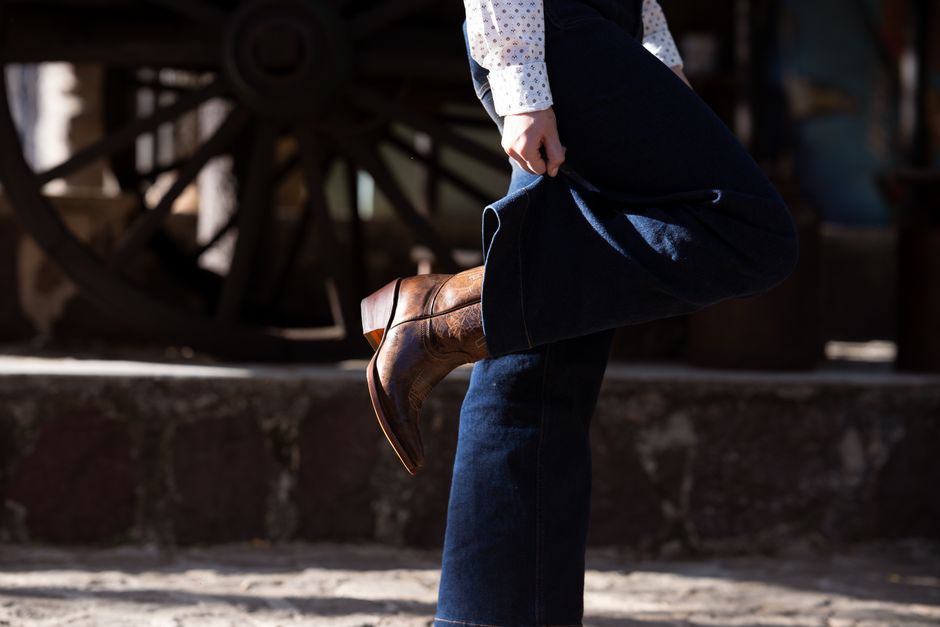
My strongest recommendation is to leave a deliberate gap between the skirt hem and the boot top when the skirt is a midi. A gap of about two to four inches gives the outfit breathing room, shows that the boot height was chosen on purpose, and stops the hem from appearing stuck to the shoe; the gap should be filled with opaque tights or a close-matching sock in cold weather, because exposed skin is not a styling requirement and usually makes the outfit less useful.
The mistake is not showing too little leg; the mistake is ending every layer at a different random point, so the eye sees the skirt hem, the boot top, the sock edge, and the coat hem as separate interruptions; repeat one color through the tights and boot, then the gap reads as one narrow transition instead of a bright stripe that cuts across the calf.
This rule also explains why a knee-high boot can look crowded under a long midi skirt while an ankle boot looks clean: the taller boot places its top inside the skirt’s visual zone, but the ankle boot keeps the boot shape below the hem and lets the skirt remain the main feature; for a neat winter silhouette, choose the ankle boot with the midi and save the knee-high pair for a shorter skirt.
If the skirt is very full, reduce the gap toward two inches and use a firmer boot; if the skirt is slim and straight, three to four inches creates a lighter line; for a short skirt, reverse the rule and use a tall shaft so the exposed area remains narrow, warm, and visually connected.
Mistakes That Ruin Boots-and-Skirts Outfits

The most useful buying advice is often a list of what not to do. These mistakes affect comfort, proportion, and how often you will wear the boots.
- Buying the boot before measuring the skirt. Take the skirt length from the waistband to the hem, then compare that measurement with the boot shaft. A boot that looks perfect on a short skirt may disappear under a midi.
- Ignoring calf width. A tall boot should sit close to the calf without pinching. Measure the widest point while wearing the tights or jeans you plan to use. A shaft that is too loose creates folds; one that is too tight makes the skirt ride up.
- Using a heavy sole with every skirt. Lug soles add useful traction and warmth, but they can overpower a narrow pencil skirt or lightweight satin. Put them with denim, corduroy, wool, or pleated fabric instead.
- Choosing a boot top that hits the widest calf point. This is the most common proportion problem. Move the shaft lower, choose a knee-high shape, or let the skirt cover the top entirely.
- Leaving the ankle unprotected in a winter outfit. A tiny strip of bare skin between a midi hem and an ankle boot looks unfinished and feels cold. Use opaque tights, wool socks, or a boot with a higher collar.
- Buying a dramatic boot for a narrow wardrobe. An over-the-knee boot is a focused purchase. Do not buy it if most of your skirts are midi or maxi. Choose an ankle boot instead and spend the difference on a better sole, lining, and fit.
- Ignoring the coat hem. A long coat should usually cover the skirt hem or finish clearly above it. A coat ending one inch below the skirt creates a crowded stack of lines, especially with a tall boot.
For the most reliable cold-weather wardrobe, start with one flat ankle boot, one sleek knee-high boot, and opaque tights in black or dark brown. That small range covers the largest number of skirt lengths and keeps the proportion decisions clear.