

Industry data consistently places coats at the top of fashion return rates — some retailers report 30–35% return figures for outerwear. Walk through any charity shop in winter and you will find racks of coats that look barely worn. Not because people stopped caring about style. Because they bought the wrong type.
There are eight distinct coat silhouettes. They differ in warmth, construction, formality, and who they are actually designed for. Knowing which one matches your climate, your wardrobe, and your body proportions is the difference between a coat you wear every day for five years and one that spends winter on a hanger.
The 8 Coat Types Compared at a Glance
This is the full picture before any detail. Warmth is rated 1–5, where 1 handles mild weather above 15°C and 5 handles extreme cold below -10°C. These are not style opinions — they reflect insulation type, fabric weight, and construction design.
| Coat Type | Warmth (1–5) | Formality Level | Best Temperature Range | Price Range |
|---|---|---|---|---|
| Trench Coat | 2 | Smart casual – formal | 10–18°C | $120 – $2,500 |
| Wool Overcoat | 4 | Business – formal | 0–10°C | $200 – $3,000+ |
| Pea Coat | 3 | Casual – smart casual | 5–15°C | $80 – $600 |
| Puffer / Down Coat | 5 | Casual | -10 – 5°C | $100 – $1,200 |
| Duffle Coat | 3 | Casual | 5–15°C | $100 – $800 |
| Wrap Coat | 3 | Smart casual – formal | 5–15°C | $100 – $1,500 |
| Teddy / Shearling Coat | 3–4 | Casual – smart casual | 0–12°C | $80 – $2,000+ |
| Cocoon Coat | 3 | Fashion-forward casual | 5–15°C | $150 – $1,200 |
The single most important column is warmth. A trench coat rated 2/5 is not a winter coat, regardless of how it photographs. If your winters regularly drop below 5°C, you need a wool overcoat at minimum — or a puffer for extreme conditions. Buying for aesthetics before checking warmth rating is the root cause of most coat regret.
Price ranges here are wide because quality within each type varies enormously. A $120 trench from Zara and a $2,100 Burberry Heritage Trench are the same silhouette — but the Burberry uses 100% cotton gabardine with a wax finish that genuinely repels water, while budget versions use synthetic blends that let water through at the seams within 20 minutes of rain. For formal or daily-use coats, fabric composition is what the price difference actually buys.
Why the Trench Coat Is Misunderstood by Most People Who Buy One
The trench coat has been marketed as the definitive all-season coat for decades. It is not. It was designed for British Army officers in World War I with one specific brief: block wind and rain in mild European weather. That brief covers roughly 10–18°C. Below that, gabardine cotton — the traditional fabric — provides almost no insulation on its own.
When the Burberry Heritage Trench sells for $2,100, the price buys construction quality, water resistance, and a silhouette refined since 1914. Not warmth. The double-breasted front and belted waist create a clean visual proportion that works over tailored trousers or straight-leg denim. But below 8°C, worn as a standalone outer layer, it consistently fails its wearer.
What a trench coat is actually built for
For cities where winters stay above 10°C most of the year — Sydney, Los Angeles, coastal Southern Europe, mild stretches of the UK — a good trench coat is the most versatile outer layer you can own. It reads formal enough for work, relaxed enough for weekends. The A.P.C. Cabourg trench ($650) and the Mango Belted Cotton Trench ($140) both perform reliably in this temperature band. The price difference reflects fabric longevity and construction finish, not warmth.
For colder cities where the trench silhouette is still wanted, two solutions exist. First: Burberry and a few other brands sell detachable wool or cashmere liners ($400–$600 separately) that push the coat’s warmth to roughly 3/5 and make it viable to around 2–4°C. Second: the Toteme Belted Wool-Blend Coat ($890) reads like a structured trench — it has the belted waist and clean lapels — but uses heavy double-faced wool. You get the silhouette with genuine cold-weather function.
The construction detail that separates functional trenches from decorative ones
Check whether the coat has a storm shield — the extra fabric flap that runs down the back from the collar. Original military trenches included it to redirect water away from the spine during prolonged rain. Most budget versions omit it or make it purely decorative with no actual coverage. If you plan to wear the coat in real rain, the storm shield matters. Burberry includes it on all heritage versions. On cheaper coats, check the back before buying: if the flap doesn’t extend at least 30cm down the back, it is decoration.
One more thing budget trenches get wrong: the belt loops. On a real trench, the belt loops are positioned to hold a cinched waist without buckling the fabric at the back. On cheap versions, the loops sit too high or too far forward, which means the moment you tighten the belt, the back of the coat bunches. Try belting the coat in the store before purchasing it.
Wool Overcoats: The Right Default for Cold-Weather Wardrobes
For anyone living through winters that regularly drop below 5°C, a structured wool overcoat is the correct starting point. The Max Mara 101801 in camel wool ($2,800) has sold continuously since 1981 for the same reason the Mackage Kent wool coat ($650) sells today: 70–100% wool at the right weight holds heat, drapes cleanly, and works from office to evening without a change of coat. That combination is genuinely hard to beat in outerwear.
Buy knee-length. Shorter wool coats lose their structural authority. Full-length coats require enough height to carry the hem without it hitting awkwardly — for most frames, knee-length is the safe and versatile choice.
How Coat Hemline Changes Your Proportions
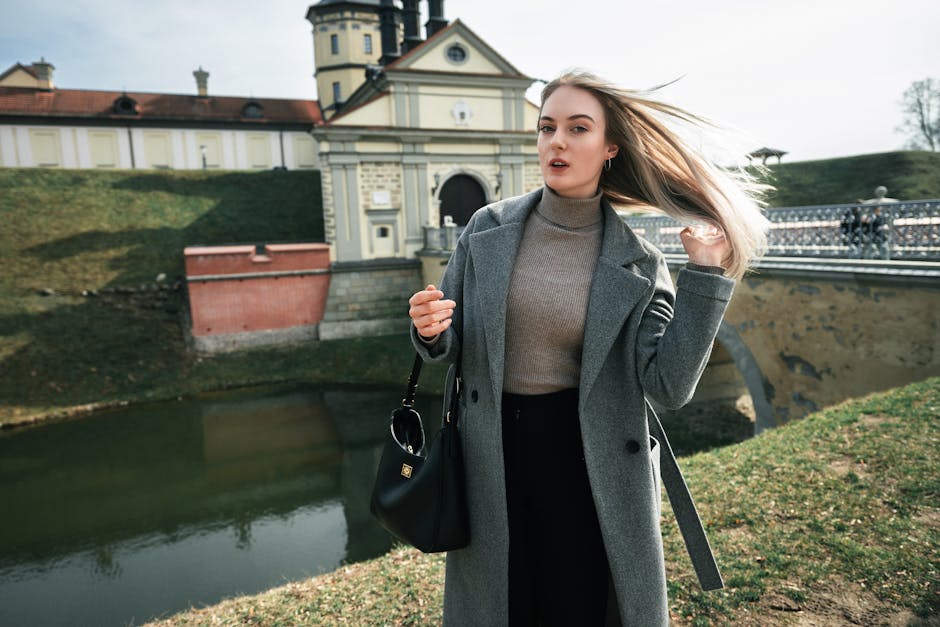
Coat length is a proportions decision before it is an aesthetic one. The hemline creates a visual cut-off point that either adds perceived height or takes it away. These rules apply across all coat types.
- Hip-length coats (pea coats, some bombers): Cut the leg line at the widest point of most bodies. Work best on tall frames or narrow hips. On petite or pear-shaped frames, they visually widen the midsection and shorten the leg.
- Thigh-length coats: The most forgiving cut for the widest range of body types. Long enough to create visual flow from torso to leg, short enough to preserve visible leg length. The Zara Belted Thigh-Length Coat ($120) and the & Other Stories Wool Blend Coat ($310) demonstrate the format at different price points.
- Knee-length coats: The standard cut for structured overcoats and trenches. Works cleanly across most heights. Particularly strong when wearing straight-leg trousers, as the hemline creates a continuous vertical line.
- Midi-length coats (below knee, above ankle): Dramatically elongates the silhouette on frames 5’6″ and above. On shorter frames, the hemline often lands at the widest point of the calf — adding perceived bulk to the lower leg rather than elongating it.
- Full-length or maxi coats: Best on tall, narrow frames at 5’7″ and above. Below that height, the coat tends to dominate the person wearing it rather than frame them.
The detail most guides miss: the key is where the hemline falls relative to the knee, not just its absolute length. A coat ending 2 inches above the knee reads as a deliberate, confident short coat. The same cut hitting 2 inches below the knee reads like a proportion error. The knee is the visual anchor — position yourself relative to it, not to a generic length category.
For frames under 5’4″, thigh-to-knee cuts consistently outperform midi options from the same brands. For frames above 5’8″, midi and below-knee cuts find their proportional peak — taller bodies carry the length without the silhouette becoming overwhelming. Acne Studios and & Other Stories both carry multiple lengths in their seasonal coat ranges, making side-by-side comparison in-store genuinely useful before committing online.
Specific Coat Types: Honest Answers to Common Questions
Are puffer coats ever appropriate beyond casual settings?
Rarely above smart casual. A slim, structured puffer like the Moncler Maya ($1,100) or the Canada Goose Shelburne Parka ($900) works for creative offices and casual dinners. But at formal occasions, the quilted texture reads dressed-down regardless of brand or price point — it is a visual signal tied to the silhouette, not the quality. If you need warmth and formality at the same time, a wool overcoat with a cashmere scarf covers far more occasions than any puffer. Use the puffer for genuinely cold outdoor conditions where its warmth advantage — fill power above 600 down — is the actual priority.
What is a duffle coat good for, specifically?
The duffle coat — defined by toggle closures, an attached hood, and thick boiled or melton wool — is a cold-weather casual coat with a clear design lineage from British naval use in the 1940s. The Gloverall Original Duffle ($550) is the version most references point to when describing a proper duffle. It handles 0–10°C well, layers generously over chunky knits, and suits commutes, weekends, and relaxed environments without pretending to be something it isn’t. Its informality is a design feature, not a limitation. Don’t force it into boardroom contexts; it will read mismatched rather than intentional.
What is the real difference between a teddy coat and a shearling coat?
Teddy coats use fluffy synthetic fabric — usually polyester boucle — designed to mimic the look of sheepskin or shearling. Real shearling uses actual sheepskin with the wool left intact: the exterior is suede-finish leather, the interior is natural wool. Real shearling is significantly warmer, heavier, and more expensive ($600–$2,000+ for quality pieces). Teddy coats start around $80, are lighter, and machine-wash more easily. Both sit in the 3–4 warmth range, but real shearling sustains warmth better in prolonged cold. For the aesthetic at a lower price point, teddy coats deliver. For function in genuinely cold climates, real shearling or a high fill-power down coat performs better.
The Mistakes That Produce a Coat You Never Wear
Buying for the climate you wish you had instead of the one you live in. This sounds obvious. It isn’t — it’s the single most common error. Someone in Edinburgh buying a trench because Italian street style makes it look effortless. Someone in Melbourne buying a Canada Goose Expedition Parka ($1,050) rated to -30°C when Melbourne winters rarely drop below 7°C. The coat either under-performs or over-performs for the conditions, and in both cases it gets left behind.
Wool blend without a percentage is a red flag. A coat that is 20% wool and 80% polyester performs like polyester — prone to static, less breathable, and with a shorter lifespan before pilling. For any coat above $200, the target is 60%+ wool for mild winters and 80–100% for cold climates. The Mango 75% Wool Belted Coat ($160) and the & Other Stories Herringbone Wool Coat ($310) both specify composition clearly on their product pages. Any listing that hides or omits the wool percentage is almost always concealing a number below 40%.
Buying a silhouette online that you have never tried in person. The cocoon coat is a textbook example. It is oversized, wide-shouldered, and deliberately enveloping — and on certain frames, particularly tall ones with narrow shoulders, it creates a striking and intentional statement. On others, it removes all waist definition and adds perceived bulk across the upper body. No product photograph conveys this, because models are selected precisely for the frames that carry the silhouette well. Try the shape in any store that stocks it before ordering. The same applies to the wrap coat, which falls completely differently on a narrow-hipped frame versus a fuller one.
The person who spends $250 on the right coat type for their actual climate and proportions wears it every day for five winters. That’s how the 30–35% return rate gets beaten — and how the barely-worn coats stop ending up in charity shop racks.