

Most people own 47 items of clothing but wear the same 8. The reason isn’t laziness — it’s uncertainty. A 2026 survey from YouGov found that 62% of women and 54% of men say they struggle to pair colors confidently. That hesitation costs you time every morning and money on clothes that never leave the hanger.
Color combination for outfits isn’t about memorizing a color wheel. It’s about one structural rule that interior designers, graphic artists, and the best-dressed people in any room already use. The 60-30-10 rule.
Here’s what it means: 60% of your outfit is one dominant color. 30% is a secondary color. 10% is an accent. That’s it. Three numbers. No guesswork.
What the 60-30-10 Rule Actually Looks Like on Your Body
The rule works because the human eye craves balance. Too much of one color feels flat. Too many colors feel chaotic. 60-30-10 creates a visual hierarchy that your brain registers as “put together” without you consciously knowing why.
Breaking down the three layers
60% — The dominant color. This is your base. For most outfits, that’s your pants or skirt plus your top if it matches. Think navy trousers with a navy sweater. Or a camel coat over a cream dress. The dominant color sets the mood. Dark colors = formal. Light colors = casual. Bright colors = bold.
30% — The secondary color. This creates contrast. It should be noticeably different from the dominant color but not fight it. If your 60% is navy, your 30% could be white, gray, or burgundy. The secondary color typically lives in your jacket, blazer, or a second layer like a cardigan or vest.
10% — The accent color. This is where you have fun. A scarf, a handbag, shoes, a belt, or jewelry. The accent should be the brightest or most saturated color in the outfit. It draws the eye intentionally. A red lip counts as accent. So does a cobalt blue bag against an all-black outfit.
Real example: the navy and white outfit
Navy wool trousers (60%), a cream silk blouse (60% — same color family), a white linen blazer (30%), and tan leather loafers with a matching belt (10%). The tan shoes and belt are the accent. The white blazer separates the top and bottom while keeping the palette clean. This outfit works because the 10% accent is the smallest visual area but the most memorable.
Three Color Combination Mistakes That Kill Your Outfit
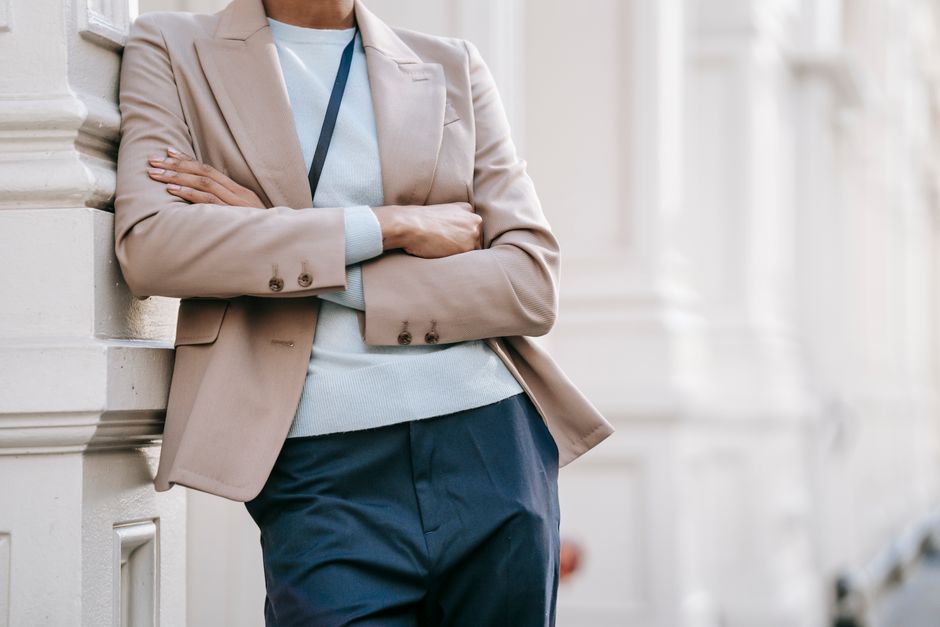
I’ve watched people make these exact errors in dressing rooms, on Zoom calls, and at dinner parties. They’re not style failures — they’re logic failures. Here are the three most common and how to fix each one.
Mistake 1: Equal color distribution
Black top, white pants, red shoes. Three colors, equal visual weight. The result? A checkerboard effect. Your eye doesn’t know where to land. The fix: make one color dominant. If you want to wear black and white, let black be 60% (black pants, black top) and white be 30% (white blazer or white scarf). The red shoes stay at 10%. Now the outfit has a focal point.
Mistake 2: Two bright colors competing
A cobalt blue dress with an emerald green bag. Both saturated. Both demanding attention. They cancel each other out. The fix: only one saturated color per outfit. Make the other colors neutral — black, white, gray, beige, navy, or olive. Let the bright color be the 10% accent or the 30% secondary, never both.
Mistake 3: Matching instead of coordinating
Matching your bag to your shoes to your belt to your watch band. This looks costumey and dated. The fix: coordinate, don’t match. Your shoes and bag should be in the same color family but not identical. A cognac leather bag with dark brown suede boots works. A black bag with black patent heels is too on-the-nose. Let the 10% accent be slightly different in texture or shade from the 30% secondary.
Color Palettes That Practically Dress Themselves
Some color combinations are mathematically reliable. They work across skin tones, body types, and occasions. Here are five palettes you can use today with zero anxiety.
| Palette Name | 60% Dominant | 30% Secondary | 10% Accent | Best For |
|---|---|---|---|---|
| Classic Neutral | Black, charcoal, or navy | White or cream | Tan, cognac, or gold | Office, interviews, client meetings |
| Warm Earth | Olive green or camel | Cream or beige | Terracotta or rust | Casual brunch, daytime dates, fall |
| Cool Monochrome | Slate gray or heather | Light gray or silver | Ice blue or lavender | Evening events, winter, minimalist looks |
| Bold Pop | White or cream | Black or navy | Bright red, fuchsia, or electric blue | Parties, dinners, photos |
| Denim Base | Medium blue denim | White or chambray | Mustard yellow or burgundy | Weekend, travel, casual work |
These palettes work because they respect the 60-30-10 structure. The dominant color is always a neutral or near-neutral. The secondary color is a lighter or darker version of the same family. The accent is the only saturated element.
When to Break the 60-30-10 Rule (And When Not To)

The rule is a starting point, not a prison. But breaking it requires understanding why it exists in the first place.
When you should break it
Monochrome outfits. A head-to-toe black outfit with varying textures — matte wool, shiny leather, sheer silk — uses 100% one color. That works because texture creates the visual separation that color normally provides. Same for all-white or all-cream looks. The 60-30-10 rule becomes a texture rule instead.
Patterns and prints. A floral dress with five colors in the print can’t follow 60-30-10 literally. Instead, pick the dominant color in the print as your 60% and pull the accent color from the smallest detail in the pattern. If the print has a tiny yellow flower, your yellow bag is the 10% accent. The dress itself becomes the 90%.
Statement pieces. If you’re wearing a bright red coat, that coat is the 10% accent even though it covers 60% of your body. The rule inverts: the statement piece is the accent by visual impact, not by surface area. Wear black or white underneath and let the coat do the work.
When you should NOT break it
If you’re attending a formal event, a job interview, or a wedding, stick to the rule. These situations demand clarity and confidence. The 60-30-10 rule delivers both. Breaking it in these contexts reads as “trying too hard” or “didn’t think about it.”
If you’re shopping for basics to build a capsule wardrobe, the rule helps you buy pieces that actually combine. A navy blazer (30%) works with white trousers (60%) and a tan bag (10%). But a neon green blazer only works if your entire wardrobe is built around that one accent color. Most people don’t have that wardrobe.
How to Build a Color Palette From Your Existing Closet
You don’t need to buy anything new to start using color combinations that work. Here’s a 15-minute exercise that will surface 20+ outfits you already own.
Step 1: Pull your five most-worn items
These are your dominant pieces. Probably black pants, dark jeans, a navy skirt, a gray sweater, a white blouse. Write down their colors. These are your 60% options.
Step 2: Pull your five second-layer items
Jackets, blazers, cardigans, vests, or statement tops. These are your 30% options. Note their colors. If they’re all black, you need one contrasting layer. If they’re all beige, you need one dark layer. This is where a single purchase — a camel blazer, a navy cardigan — unlocks dozens of combinations.
Step 3: Pull your five accessories
Shoes, bags, scarves, belts, jewelry. These are your 10% accents. The most versatile accent colors are: tan, burgundy, cognac, gold, silver, and a single bright color like red or cobalt blue. If all your accessories are black, your outfits will feel flat. One colored bag or pair of shoes changes everything.
Step 4: Map combinations using the table above
Match your existing items to the palettes in the table. If you own olive trousers (60%), a cream blouse (60%), a tan blazer (30%), and burgundy loafers (10%), you have the Warm Earth palette ready to go. You don’t need a single new item.
Color Psychology: What Your Outfit Communicates Before You Speak

Colors carry meaning. Not universal meaning — cultural and personal context matters — but there are patterns backed by decades of consumer research.
Black signals authority, seriousness, and formality. It’s the dominant color in most interview outfits for a reason. But all-black can read as closed-off or intimidating. Adding a 10% accent in a warm color — gold jewelry, a tan belt — softens the message.
Navy signals trustworthiness and stability. It’s the most common color in corporate environments because it projects competence without aggression. Navy works as a 60% or 30% in almost any palette.
White signals clarity, purity, and freshness. It’s the safest 60% for summer and the safest 30% for any season. But white is unforgiving — it shows every wrinkle, stain, and poor fit. If your white pieces aren’t in excellent condition, swap them for cream or ivory.
Red signals confidence, energy, and passion. It’s the most effective 10% accent color because it demands attention. A red bag, red lip, or red shoe makes an outfit memorable. But red as a 60% dominant color reads as aggressive or theatrical. Save it for occasions where you want to be the center of attention.
Green signals calm, nature, and approachability. Olive and sage greens work as neutrals. Emerald and forest greens work as accent colors. Green is underused in most wardrobes, which means it stands out without screaming.
Blue signals calm, intelligence, and reliability. Light blues feel approachable. Dark blues feel authoritative. Blue is the most universally flattering color across skin tones. If you own nothing else, own blue.
The Verdict: Your Color Combination Strategy for 2026
The 60-30-10 rule isn’t a trend. It’s a perceptual constant. Human vision processes color in hierarchies, and this rule maps directly to how your brain works. You can fight it, but you’ll lose.
Here’s the strategy: pick one neutral as your 60% anchor. Navy is the safest choice because it works with every skin tone, every season, and every occasion. Build your 30% secondary around white, cream, or gray. Choose one accent color — tan, burgundy, or red — and buy three accessories in that color: a bag, a shoe, and a scarf or belt. That’s it. Three purchases. Unlimited combinations.
The people who look effortlessly put together aren’t spending hours on color theory. They own fewer pieces that work harder. The 60-30-10 rule gives you permission to stop guessing and start dressing.
Color combination for outfits comes down to three numbers. Everything else is just shopping.